
REDEEMING BIM’S PROMISE IN PRACTICE: INTEGRATIVE PLANNING WITH HILTI AS A PARTNER
Pavel Cerny (1), Alexandre Marques (2)
(1) Hilti Nederland B.V., Rotterdam
(2) Hilti Portugal, Porto
Abstract
The current paper aims to share Hilti’s experience on BIM, as a global company. We present our vision on BIM and the rationale behind our committed investment in this area. We have developed a set of BIM Design Services, that offer customers the possibility to design and install the support system for different trades in an integrated way (including Mechanical, Electrical and Plumbing (MEP) trades). Our offer is structured around four design services: Framework, Design, Modeling and BIM Output. We share and discuss how these services can add value to a project, through design optimization (savings on material, time and space on the jobsite), prefabrication (better quality, execution time and safety), advanced logistics (improvements in project management) and BIM-to-Field (more precision and productivity in the positioning of elements). Finally, we assess our worldwide experience in BIM projects in terms of return on investment (ROI).
1. The relevance of BIM for Hilti
1.1. Hilti an innovation driven company
Hilti aims to make construction work simpler, faster and safer, with products, systems, software and services that provide clear added value. Our brand stands for quality, innovation and direct customer relationship. This mindset drives the company to invest approximately 6 percent of annual sales into research and development [1].
Throughout the years we have been bringing innovative solutions to the market like our direct fastening technology, or our fleet management services. Innovation is in our DNA. Our direct business model allows us to tap into customer’s pain points and steer our innovation efforts to address the most critical pain points. Productivity has been a key pain point of our customers throughout the years, and a key target of Hilti’s solutions.
1.2. The importance of BIM and why Hilti can make a difference
Productivity gains have been achieved in many industries worldwide in the last decades. The manufacturing industry, for instance, nearly doubled its productivity in the past 20 years. The construction industry, however, has not followed this trend, and productivity in this industry has been flat for decades. A research driven by McKinsey [2] shows that 98 percent of megaprojects suffer cost overruns of more than 30 percent, and 77 percent are at least 40 percent late.
Many factors could justify the poor productivity observed in the construction industry, and include some of the following:
- Poor organization;
- Inadequate communication;
- Flawed performance management;
- Insufficient planning.
On the positive side however, some practices are emerging that can drive higher productivity at different stages of a project, from concept and design to project execution. Examples of these practices are: modular design, standardization, prefabrication and Building Information Modeling (BIM). BIM promises the highest savings and efficiency in all project phases. BIM can significantly improve project planning through better coordination of all relevant stakeholders, also driving time and cost savings (e.g. avoid design clashes and reduce bill of materials). Better planning will enable smooth project management in the execution phase and facilitate maintenance during operations. Furthermore, BIM allows all relevant project information to be stored in a single location and with a significant level of detail (e.g. 3-D models, structural and non-structural details). Although BIM implementation is gaining momentum, it often still stumbles with complexity and scalability.
As an innovation company, Hilti sees BIM as an opportunity to bring real added value and productivity to its partners. Furthermore, Hilti is strategically positioned to provide such services. Hilti has been for long a successful consultant in the planning as well as a partner providing leading solutions during the construction phase. With its BIM services, Hilti now combines the strengths of both phases with a project partnership over the entire workflow.
1.3. Achieving global excellence and scalability
Our BIM journey started a few years ago with the development of BIM objects for our products. In 2015 our customers in the Netherlands started demanding our participation in BIM projects, and we realized our BIM offer had many shortcomings (e.g. we had 3D-objects but no parametrized embedded BIM content in them). Despite the challenges we faced at this time, our experience in the Netherlands showed us the positive impact of BIM on productivity and it accelerated Hilti’s commitment in this area. We created a new role at Hilti – ‘BIM Project Manager’ – someone that could talk to customers on a professional level and liaise with relevant Hilti stakeholders (engineers, logistics, etc.) to connect the professional design of fastening and fire-protection solutions with the client's BIM model. As our involvement in BIM projects started to grow across other central European markets, we realized the need for a standard and scalable approach. We defined three standard roles: ‘BIM Project Manager’, ‘BIM Lead Engineer’, and ‘BIM Modeler’ to cover all relevant steps of a BIM project. We defined the skills needed for each role and developed an internal certification program to ensure a high service level across all our markets. Furthermore, we created a Global BIM Competence Center in Rotterdam to run this training program, and in parallel to support our market organizations in the most complex projects. Through this approach we have been able to scale our BIM services worldwide ensuring a high level of professionalization. Another pillar of our approach is reducing complexity to a minimum. We have been using a standardized software-landscape as well as modular parametric BIM objects with this aim.
We have built a strong service offering along the complete workflow. The value of "BIM with Hilti" comes through partnership across the entire workflow such as the integration of different trades into one fastening solution (multi-trade solution). Pre-Fabrication of supports, Advanced Logistics and BIM2Field are among some of the examples of productivity gains which we call "BIM Use-Cases". A client can pick and choose where to start within the workflow. In the following chapters of the current paper, we will further detail our BIM Design Services and overall project approach.
2. Hilti BIM Design Services
More and more BIM is being used in construction projects. BIM is used to plan pipes, ducts and cables, however the matching mechanical, electrical and plumbing supports are often not considered in the design stage and, thus are not on the BIM model. As a result, each trade commonly defines their own supports more based on experience rather than Engineering [3]. This workflow very often leads to challenges at the jobsite, namely:
- Coordination problems (on-site clashes);
- Improvised solutions – not properly engineered;
- High waste of material;
- Too much time invested in ordering material; • Incomplete documentation;
- Etc.
Figure 1 shows two real case projects where the MEP supports were installed using the traditional single-trade approach with little planning and engineering.
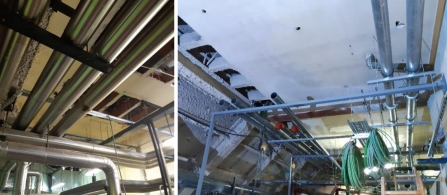
Figure 1: Real cases with MEP supports defined on the jobsite.
With the goal to improve productivity along the entire workflow including definition, installation and operation/maintenance of MEP systems, Hilti has developed the BIM Design Services. We offer four types of BIM Design services supported by dedicated BIM project teams that can offer deep expertise in terms of products (including MEP fastening and support solutions and passive firestop solutions), engineering (design and modelling) and project management. These services complement each order and are further described below.
2.1. Framework
In the Framework service (BIM Service 1), Hilti’s BIM team develops the overall project approach to design MEP supports. The project approach includes an estimation of the cost and time of the full design effort. The project is sectioned in individual areas, with re-occurring requirements and for each Hilti MEP support conceptual solutions are proposed. Hilti works in a logic of project optimization in the interest of lean design, modeling and tendering, productive installation and reliable inspection processes.
2.2. Design
In the Design service, Hilti’s BIM team further develops the conceptual solutions identified during the Framework. We follow the Pareto principle of ~80/20, i.e. we aim to cover the maximum area or set of applications with minimum variation of supports. In other words, we try to achieve high standardization. This principle is balanced against project and customer specific needs. Complex areas such as technical rooms require a customized, specific approach. The proposed solutions are supported by Engineering reports and individual bills of materials. Hilti design tools are based on finite elements and are state of the art in terms of parametric design. With this approach we can very effectively prepare the necessary input for Modelers (the next step of our BIM Design Services) and allows us to ensure the best solutions based on project requirements.
2.3. Modeling
In the next stage, the Hilti MEP supports that were designed are now modeled and integrated into the BIM models of the project. Using various software tools, Hilti strives to provide a clash-free model and high automation with smart modeling functions. Hilti’s BIM model is provided at LOD 400 [4].
2.4. Data extraction
In the last stage, the finalized BIM model is used to extract information that can support the installation process, namely drafting shop, prefab or plan view drawings, layout points, precise bill of materials, inputs for logistics, etc.
Figure 2 shows the progress of the model along with the development of the different services:
design (left), modeling (middle) and data extraction (right).

Figure 2: Progression of BIM Services: Design (left), Modeling (middle) and Data Extraction (right).
3. Sources of Productivity
Based on our worldwide experience with BIM Design Services we have identified six main sources of productivity gains, which we call “BIM Use-Cases”. These are:
- Design Optimization;
- Pre-fabrication;
- Advanced Logistics;
- Validation (not discussed in this article);
- BIM to Field;
- Field to BIM (not discussed in this article).
3.1. Design Optimization
Traditionally, and as previously mentioned, each trade works independently from each other. Each trade separately defines their own supports and subsequently installs them at different points in time.
Hilti follows an optimized project approach, striving to organize as much as possible all trades into the same support – Hilti’s multi-trade supports. In Figure 3 a real case example is shown where we converted the traditional single trade supporting system (on the left) to a single multitrade support system (on the right).

Figure 3: Going from traditional single trade (left) to multi-trade supports (right).
This project approach can lead to significant savings on the jobsite, namely:
- Reduction of the number of supports;
- Reduction of the number of anchors;
- Reduction of assembly time;
- Reduction of space;
- Better coordination of the different trades and among subcontractors – a BIM model is shown in Figure 4 with a traditional support approach (left) and multi-trade approach (right).
In our experience material and time costs can be reduced as much as 40% with such an approach. Coordinating and planning efficient work among MEP contractors is a difficult task, and it requires a strong support of the owner, designer and/or general contractor.
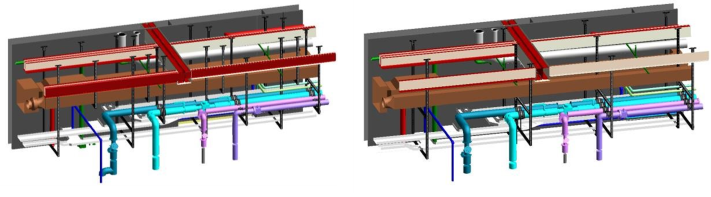
Figure 4: Traditional single trade approach (left) and multi-trade approach (right).
3.2. Pre-fabrication
As mentioned in Chapter 1, other industries, like the automotive industry, have embraced standardization and modularity as key drivers for productivity. In the construction industry, every building is different. When fabrication happens on-site, there are always uncertainties to be considered. Missing elements on the project and the complexity of the installation process can become an issue. This results in an inefficient installation process often with compromised quality. Using lean construction principles, Hilti’s partners can improve this situation. The output of Hilti’s BIM services is a BIM model with all the MEP supports and needed information to enable pre-fabrication, i.e. (partial) assembly of the designed supports in a production environment instead of at the jobsite. Hilti case studies have shown that pre-fabrication can increase job site productivity up to 70 % in terms of combined time and material savings. Furthermore, pre-fabrication promotes higher safety during installation and build-as-designed solutions.
In Figure 5 we show an example of a project where the MEP supports were all defined and identified in the BIM model and were then as per model prefabricated with high precision level off-site.
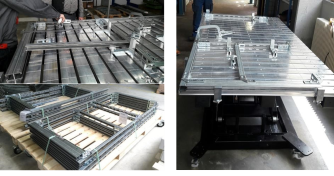
Figure 5: Prefabrication process (left upper + right) and prefabricated supports on a pallet (left bottom).
Smart prefabrication parameters are applied in the prefabrication definition, such as maximum weight, geometry of assemblies, pre-assembly phases and tightening torques and all tolerances due to high precision and off-site conditions.
3.3. Advanced logistics
Successful delivery and profitability of a construction project are heavily influenced by accurate material and resource planning. It becomes increasingly important to trace the progress of production, delivery and timely installation. Hence, project managers spend significant time maintaining transparency on progress and supply chain information. Live information throughout the supply chain process is a key success factor.
Having Hilti’s BIM detailed model enables our team to extract information, including quantities for all the project, but also filter that information, regarding different areas and at different stages of the project (BIM 4D).
All this information is coordinated with our logistics team, to ensure timely delivery of the material to the jobsite. Figure 6 shows an example of an advance logistic platform piloted on a project, where through the BIM model, the project manager is able to plan and deliver Hilti’s material on the jobsite fully aligned with the project’s workflow. Information is transmitted via QR code on every solution and phase scanning.
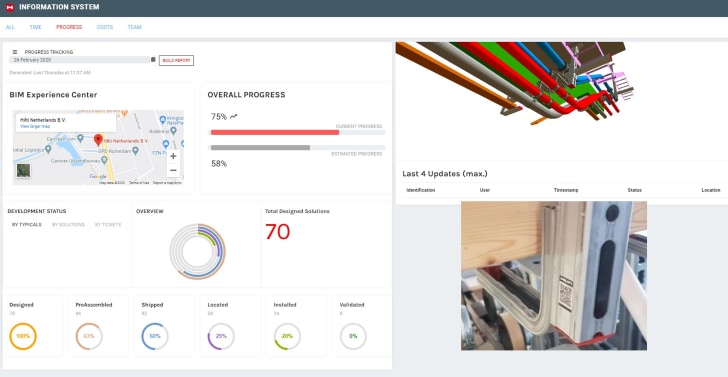
Figure 6: Advance logistic platform piloted on a project with logistics control with the BIM model.
For Hilti, BIM 4D [5] means a bi-directional and very tangible approach. Being a consultant/designer and supplier at the same time has its own advantages and challenges. Hilti BIM Engineers and Modelers can, by early specification, bring valuable parameters into production forecasting models which can be dynamically connected to the BIM models. Such approach can lead to optimized solutions, as we speak about BIM 5D – costs.
3.4. BIM to Field
Another use case proven by many projects is BIM to Field. To this day, it is still common practice to use tools like ropes and duct tapes to lay out positions on the jobsite, including the fastening points of the MEP supports. This is a very time-consuming task that can lead to large deviations from the designed grid.
Having engineered and optimized MEP support solutions in the BIM model, allows our partners to utilize the latest measuring and laser tools to lay out the positioning of the supports and its fastening points. Hilti’s BIM model includes fastening to concrete anchoring solutions and invasive and non-invasive fastenings on steel. Furthermore, Hilti’s BIM model has an add-in for the BIM platform Revit allowing us to create specific BIM objects related to the fastening points of the supports. This add-in enables the 2D/3D information to be converted in a CSV file, which can be read by Hilti’s construction layout tool – the PLT 300. Finally, this tool is able to lay out on the jobsite all the points marked on the BIM model. This workflow is shown in Figure 7.
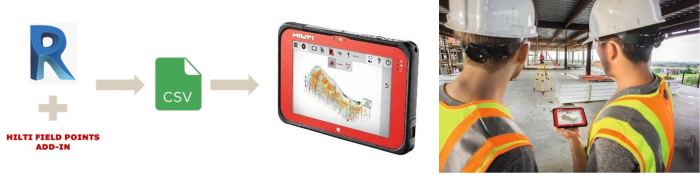
Figure 7: BIM to Field workflow.
Having the PLT 300 available to lay out the fastening points, can lead to process time savings up to 80%, according to Hilti’s experience. It is also a much more precise way of positioning the elements, comparing to the traditional way, with an accuracy of 3 mm up to a distance of 50 meters.
4. Main conclusions
At Hilti we have roughly 250,000 individual interactions daily with our customers, which gives us privileged insight into the challenges and trends of our industry [1]. The pressure keeps mounting to build faster, safer and at the same time cheaper. Based on our experience we believe that BIM can be a key enabler for a step change in productivity in the construction industry, taking projects exactly in this direction – faster, safer, cheaper.
For the moment, Hilti’s BIM Design Services are focused on optimizing the planning and execution of mechanical, electrical and plumbing (MEP) trades, as this is at the core of our expertise. Key areas of improvement in these workflows are:
- Execution of the MEP supports as usually, each subcontractor plans and installs their own trade system independently of each other. This often results in clashes between trades at the jobsite, with consequent waste of space, time and materials;
- On-site assembly of MEP supports, associated with high labor costs and material waste;
- Inefficient logistics coordination, often with wrong quantities of material and at the wrong time on the jobsite;
- Labor-intensive and imprecise methods regarding the positioning of MEP elements.
We offer four BIM Design Services (Framework, Design, Modeling and BIM Output) that can drive real life productivity around the dimensions of Design Optimization, Prefabrication, Advanced Logistics, BIM-to-Field, Field to BIM and Validation. Furthermore, due to Hilti’s business model, which has spanned design and execution phases for many years, we believe we are well positioned to redeem BIM’s promise in practice.
Our approach requires customers to invest more in planning and in particular our BIM Design Services require an up-front investment from our partners in the Design phase. What we have consistently observed is that this investment will later lead to significant savings during execution, and a consequently higher return on investment (ROI). In Figure 8 we show a typical example of the ratio between investment in BIM Design Services compared to the return during the execution phase. The typical ROI of this investment is above 3. 
Figure 8: Ratio between investment on BIM Design Services and savings during execution phase.
Hilti continues to participate in different types of projects worldwide, consolidating know-how and further developing its BIM Design Services. Our most recent investment was the opening of the BIM Experience Center, in Rotterdam, in mid 2019, which aims to make BIM a tangible experience for our partners.
References
[1] Hilti, Company Profile, accessed January 14, 2020, https://www.hilti.group/content/hilti/CP/XX/en/company/corporateinformation/company-profile.html.
[2] S. Changali, A. Mohammad, M. v. Nieuwland, "The construction productivity impertive", McKinsey&Company, June 2015.
[3] Hilti, Hilti BIM Services, accessed January 13, 2020, https://www.hilti.group/content/hilti/CP/XX/en/services/engineering/BIM.html.
[4] BIMForum, Level of Development (LOD) Specification Part I and Commentary For Building Information Models and Data, April 2019.
[5] The NBS, BIM dimensions - 3D, 4D, 5D, 6D BIM explained, accessed January 15, 2020, https://www.thenbs.com/knowledge/bim-dimensions-3d-4d-5d-6d-bim-explained.
